Chronicling the completion of the backlog, one game at a time.
This is Coffee from Games with Coffee, and welcome to Backlog Busting! As the tagline above says, I’m writing about the games in my backlog that I’ve completed in 2024. I’ll share what I enjoyed, what I didn’t, and whether or not it was worth my time and investment. At the end, I’ll share a Busting Grade – an aggregate rating made up of four categories: Length, Difficulty, Replay Value and Fun Factor. Scoring explanations will be found at the end of the post for reference.
Game number six is Shadow Dancer: The Secret of Shinobi for the Sega Genesis. A sort of quasi-sequel to The Revenge of the Shinobi, it’s a different kind of side-scrolling game where if you get hit once, you die. Fun. The good thing about this game is that you assisted by a trusty and useful canine companion! Also fun! Let’s dig into the report.
Enter the Shadow Dancer
Shadow Dancer: The Secret of Shinobi, otherwise shortened to Shadow Dancer, is a loose adaptation of the arcade game bearing the same name. The arcade version was released in 1989 and was developed and published by SEGA. The game was ported to the Sega Genesis in 1990, making it the second Shinobi title released on the console, following The Revenge of Shinobi.

Story-wise, the game takes place in New York, 1997. An evil ninja cult worshipping a reptilian demon called Union Lizard has taken over the city and left it in ruins. Those who didn’t escape from the cult’s initial attack were held prisoner. An unnamed ninja and his trusty canine companion steps up to rescue the hostages and put an end to Union Lizard’s reign of terror. In the North American version, that ninja was Joe Musashi. He came out of retirement to take on the threat. In the Japanese version, it’s Joe’s grandson, Hayate.
I first learned of Shadow Dancer‘s existence from research into the Shinobi series. I had played through Shinobi III – arguably, the best Shinobi game ever – and I wanted to explore the other games. The first title, Revenge of the Shinobi, was a primitive version of the third game. The second title, the one you’re reading about now, was vastly different from the first and third games. It follows in the same veins as other games with the number 2 in it. See: Zelda II, Super Mario Bros. 2, Final Fantasy II, etc.
I tried playing Shadow Dancer through an emulator, but I didn’t like it. It was so unlike Revenge of the Shinobi and Shinobi III that I couldn’t understand how it could be considered a sequel. I decided to give it another go when I got my Genesis Mini 2 last year. I had the same result; I still didn’t like it, so, I put it away.
One night, after I beat Kid Icarus, I hopped on my Sega Genesis Classics Collection on my Switch to pick something new to play. I intended on playing Beyond Oasis or Landstalker next. Instead, I found myself trying Shadow Dancer one more time. Thanks to save states and the rewind function, I was able to beat it at last!
Busting Report
Shadow Dancer for the Genesis retains the same mechanics as its arcade inspiration. Including the death-from-a-single-hit mechanic. If you’re hit even once by a blade, a projectile or whatever, the ninja dies. A big positive is that you don’t suffer contact damage – something that I wasn’t used to in this kind of game. Even Shinobi III had contact damage. But in that game, you had a life bar. This mechanic was the major reason why I couldn’t finish this game earlier.
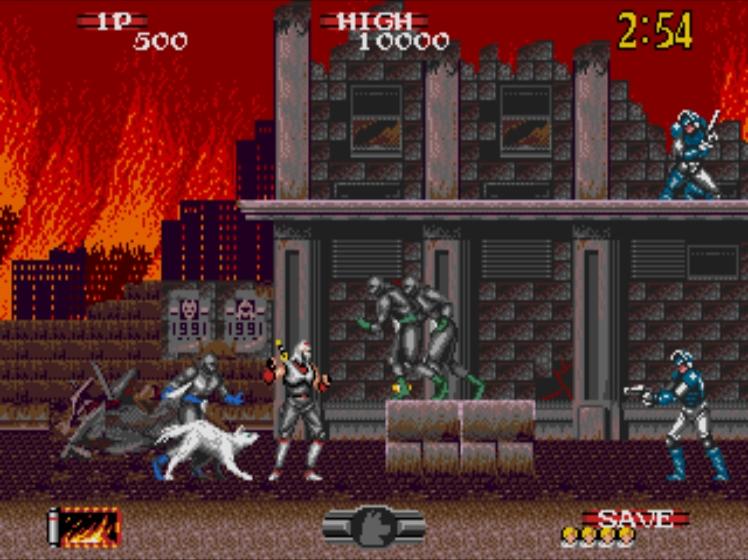
Control-wise, the ninja can move left and right. He can crouch by pressing down and can jump by pressing C. The ninja can drop down platforms by holding down and pressing C. He can also ascend a level by holding up and pressing C. For attacks, he can either throw shuriken from afar, or slash enemies with his sword at close range with the B button. He can also perform a jump kick by pressing B in midair. The ninja can cast one of three types of magic by pressing A. The type of spell you’re given is predetermined. You can only cast magic once per stage.
Aside from normal, the ninja can also command his pet dog to attack. Holding B charges a gauge at the bottom of the screen. Releasing it when it’s full causes the dog to shoot forward and attack the nearest enemy, holding it in place. Players must quickly dispatch the stunned enemy before they wrestle the dog off of them. If you take too long, the dog gets hurt and morphs into a puppy. The dog can also get hurt by trying to tackle shielded enemies. Just like Tails in Sonic 2, the dog is invincible, but you still don’t want to see him get hurt. I felt it was my duty to protect the dog more than the hostages.

The game is separated into five rounds. Each round contains a number of stages. The main objective in each stage is to rescue all of the hostages. Thank goodness they can’t be harmed by any sort of fire or else this game would be near impossible to finish. Saving hostages nets you either points or a power-up that enhances your attacks. Saving hostages is one of many ways to heal the dog after it turns into a puppy. The other’s being completing a stage or restarting after a death.

Speaking of deaths, you’re given plenty of lives to start out with instead of the standard three. It’s very generous, given that you have to play the game flawlessly to beat it. Players can earn extra lives through points or by completing the bonus round between rounds. As the ninja falls from a great height, players must shoot down all of the ninjas that approach. Doing so will earn you tons of extra lives.
You fight a boss at the end of each round. Defeating it requires you to memorize their attack patters while waiting for the best moment to attack. At the same time, you have to be careful not to get hit. The bosses were not too tough, but they feel harder thanks to the one-hit death mechanic.
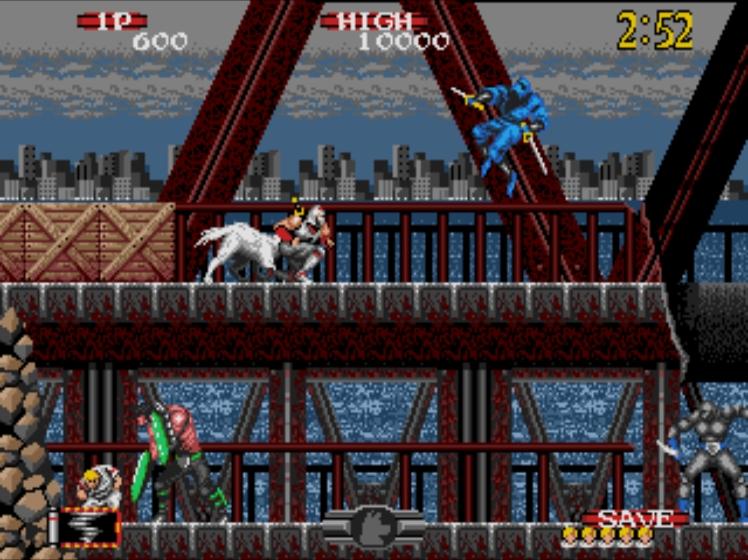
Generally speaking, Shadow Dancer is a short game. It just feels longer because of the difficulty. With its completion, I’ve finished the main Shinobi games for the Sega Genesis. I don’t see myself returning to this game, not when The Revenge of the Shinobi and Shinobi III offer a more classic Shinobi experience. At least it’s finally off of the backlog.
Backlog Busting Grade
Length: 5/5
Difficulty: 2/5
Replay Value: 1/5
Fun Factor: 2/5 + bonus point because the ninja dog is a good dog.
Busting Grade: C-
The Backlog Busting Grade is an aggregate letter grade made up of four categories: Length, Difficulty, Replay Value and Fun Factor. A high grade means that the game in review is an excellent addition to the backlog. On the other hand, a low grade means that you can choose to pass up on this title if you wish. Honestly though, the grades aren’t meant to be taken seriously – this is just me having fun with clearing my backlog. Your mileage may vary depending on preferences, time commitments, etc.
Each category is given a score out of five. Length measures how long a game took for me to complete. 5 being extremely short (30 minutes – 1 hour) and 1 being extremely long (40+ hours). Difficulty is self-explanatory – 5 for being very easy and 1 for being very hard. Replay Value scores how likely I’ll return to play again. 5 for most likely and 1 for never touching it again. And Fun Factor measures how much fun I had with the title. 5 for lots of fun and 1 for no fun at all.
Games With Coffee
Enriching the Stewards of Gaming, One Cup At A Time
 Games With Coffee