
Chronicling the completion of the backlog, one game at a time.
This is Coffee from Games with Coffee, and welcome to Backlog Busting! As the tagline above says, I’m writing about the games in my backlog that I’ve completed. I’ll share what I enjoyed, what I didn’t, and whether or not it was worth my time and investment. At the end, I’ll share a Busting Grade – an aggregate rating made up of four categories: Length, Difficulty, Replay Value and Fun Factor. Scoring explanations will be found at the end of the post for reference.
The eighth game finished for this year is Final Fantasy III Pixel Remaster for the Nintendo Switch as part of the Final Fantasy Pixel Remaster Collection. Let’s dig into the report.
Get a Job!
To be perfectly fair, this isn’t my first time playing Final Fantasy III. On the other hand, it’s also my first time playing this version of Final Fantasy III. Confusing? Let me backtrack a bit.

Back in the early 2000s or so, Square Enix started releasing remakes and remasters of their previous Final Fantasy games. In Final Fantasy III‘s case, it was remade for the Nintendo DS. Not only was it fully remade in 3D polygonal graphics, the four Light Warriors became individual characters as opposed to generics in the original title. Final Fantasy III had additional upgrades that took advantage of the handheld’s communication hardware, like the sub-quests obtained through Mognet. What set it apart from the other remakes/remasters on the GBA games was that Nintendo Hard was set as the default difficulty. Battles were hard as hell and you got penalized for switching jobs too often.
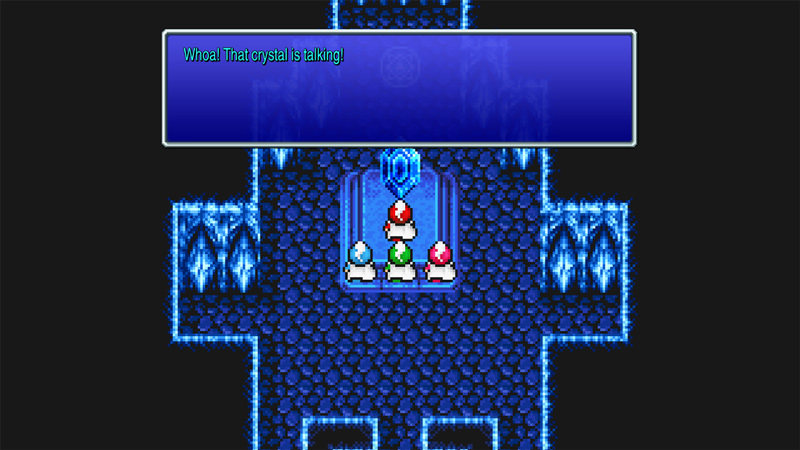
Final Fantasy III Pixel Remaster conversely tones everything down and returns it to its roots. No individual characters, no Mognet and no secret jobs or bosses. This is Final Fantasy III at its base, but with all the pretty colours, spell names and gorgeous music the franchise is currently known for. The boosts and speed-up functions for the Pixel Remasters were absolute blessings. They allowed me to get through the game fairly quickly. No longer did I have to suffer grinding for levels like I did in the DS game. Buying new equipment and magic was also a breeze. And battles came and went without too many issues. Not only was it a fun, little jaunt down memory lane, it was also a way to experience the game as it was back in the day. It’s not without its hiccups though.
My biggest annoyance was the fact that you have to use the Mini spell to progress. While it was innovative for the time, it also forced players to incorporate magic for all their characters, regardless of what role they are playing at the time. While there is a plethora of jobs available, I found that most of them were either not of great use or scenario-specific within the story. I mostly stuck with two physical jobs and two magic jobs – the recommended party setup for when you gain the Ninja and Sage jobs at the end of the game.
The final dungeon gauntlet was another thing that I took umbrage with. Sure, I had access to quick saves and auto-saves to make the journey easier, but I still don’t like that there’s no save points between the top of the Crystal Tower and the Land of Darkness, where you have to harness the power of the Dark Crystals. Fortunately, I did over-level my characters, so getting through the last part wasn’t too terrible. Against the Cloud of Darkness, however, I barely managed to claim victory. Of the group of Pixel Remaster games, Cloud of Darkness is pretty much #2 in the most difficult final fights, with Zeromus being the hardest I had to deal with. More on that on the next post.
Final Fantasy III was a fun game, but I don’t see myself revisiting it any time soon. Besides the points I made above, IV and VI are much more memorable and V’s job system is vastly superior to III’s. I can see myself revisiting it with my kids, though. So, there’s that.
Backlog Busting Grade
Length: 2/5
Difficulty: 3/5
Replay Value: 2/5
Fun Factor: 3/5
Busting Grade: D-
The Backlog Busting Grade is an aggregate letter grade made up of four categories: Length, Difficulty, Replay Value and Fun Factor. A high grade means that the game in review is an excellent addition to the backlog. On the other hand, a low grade means that you can choose to pass up on this title if you wish. Honestly though, the grades aren’t meant to be taken seriously – this is just me having fun with clearing my backlog. Your mileage may vary depending on preferences, time commitments, etc.
Each category is given a score out of five. Length measures how long a game took for me to complete. 5 being extremely short (30 minutes – 1 hour) and 1 being extremely long (40+ hours). Difficulty is self-explanatory – 5 for being very easy and 1 for being very hard. Replay Value scores how likely I’ll return to play again. 5 for most likely and 1 for never touching it again. And Fun Factor measures how much fun I had with the title. 5 for lots of fun and 1 for no fun at all.
Games With Coffee
Enriching the Stewards of Gaming, One Cup At A Time
 Games With Coffee